Dense 3D shape correspondence remains a central challenge in computer vision and graphics as many deep learning approaches still rely on intermediate geometric features or handcrafted descriptors, limiting their effectiveness under non-isometric deformations, partial data, and non-manifold inputs.
To overcome these issues, we introduce RINO, an unsupervised, rotation-invariant dense correspondence framework that effectively unifies rigid and non-rigid shape matching. The core of our method is the novel RINONet, a feature extractor that integrates vector-based SO(3)-invariant learning with orientation-aware complex functional maps to extract robust features directly from raw geometry. This allows for a fully end-to-end, data-driven approach that bypasses the need for shape pre-alignment or handcrafted features.
Extensive experiments show unprecedented performance of RINO across challenging non-rigid matching tasks, including arbitrary poses, non-isometry, partiality, non-manifoldness, and noise.
We introduce RINONet, a novel SO(3)-invariant feature extractor designed for 3D geometric learning. By revisiting the seminal architecture of DiffusionNet, RINONet implements a vector-based learning scheme that ensures rigorous rotation invariance. Unlike traditional methods that rely on handcrafted descriptors or intermediate geometric priors, RINONet extracts robust features directly from raw geometry, facilitating manifold learning in a purely data-driven manner. Furthermore, RINONet preserves the discretization-agnostic properties of its predecessor, allowing it to function as a seamless, drop-in replacement for existing DiffusionNet-based frameworks. Consequently, it can be integrated into established pipelines to achieve SO(3)-invariance with minimal architectural modification.
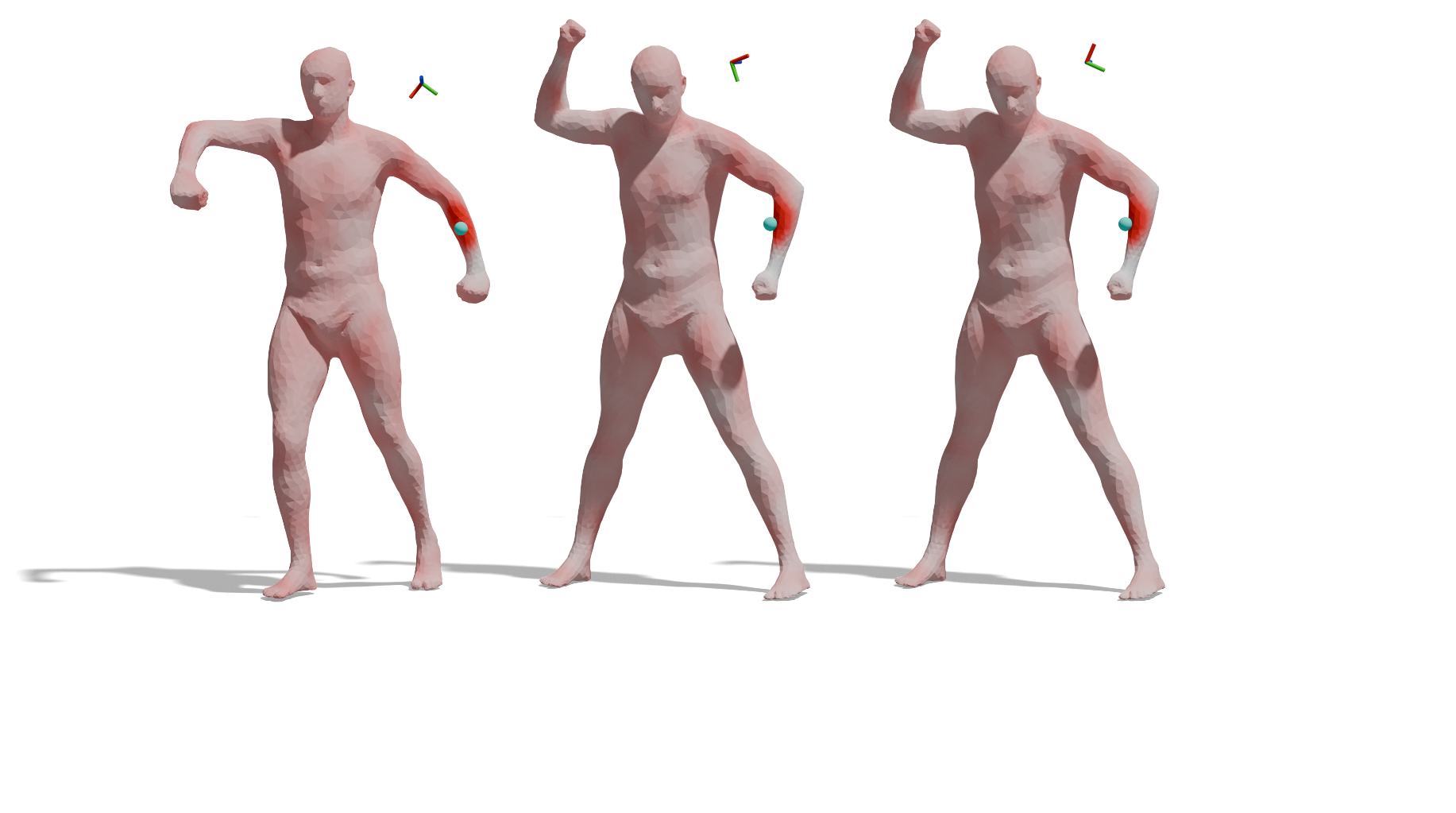
We integrate RINONet into a triple-branch deep functional map pipeline for matching non-rigid shapes. RINONet can be used for other downstream tasks such as segmentation and rigid registration.
We show our results on shape matching when using xyz input.
@inproceedings{gao2026rino,
      author 	= { Maolin Gao and Shao Jie Hu-Chen and Congyue Deng and Riccardo Marin and Leonidas Guibas and Daniel Cremers },
      title 	= { {RINO}: Rotation-Invariant Non-Rigid Correspondences},
      booktitle = {Conference on Computer Vision and Pattern Recognition (CVPR)},
      year 	= 2026,
      keywords = {Rotational Equivariance, Invariance, Manifold, Surface Learning, Shape Matching, Non-Rigid Correspondences, Functional Maps}
  }